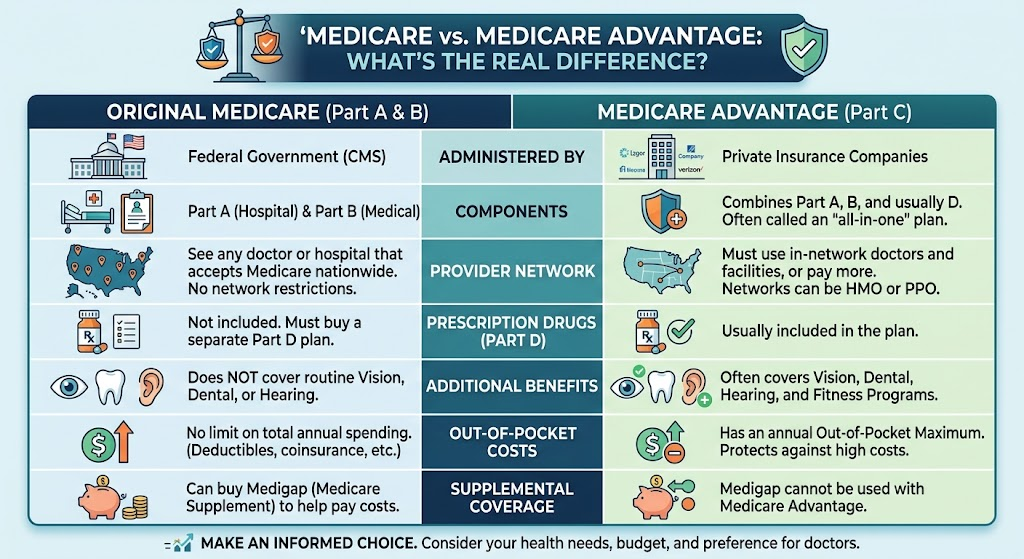
Choosing how to receive healthcare coverage after age 65 is one of the most important decisions in retirement planning. Yet the terms “Medicare” and “Medicare Advantage” often cause confusion, since they sound similar but work in very different ways. This guide breaks down exactly how each program works, using verified 2026 figures from the Centers for Medicare & Medicaid Services (CMS).
1. What Is Original Medicare?
Original Medicare is the federal health insurance program administered directly by the U.S. government. It has existed since 1965 and consists of two parts.
Part A – Hospital Insurance
Covers inpatient hospital stays, skilled nursing facility care, hospice, and limited home health care.
- Most people pay no monthly premium if they or a spouse worked at least 10 years (40 quarters) while paying Medicare taxes.
- 2026 inpatient hospital deductible: $1,736 per benefit period.
Part B – Medical Insurance
Covers doctor visits, outpatient care, preventive screenings, and durable medical equipment.
- 2026 standard monthly premium: $202.90
- 2026 annual deductible: $283
- Higher-income beneficiaries pay more through the Income-Related Monthly Adjustment Amount (IRMAA), reaching up to $689.90/month.
What Original Medicare Does Not Cover
- No prescription drug coverage (requires a separate Part D plan)
- No dental, vision, or hearing coverage
- No annual out-of-pocket spending limit
2. What Is Medicare Advantage?
Medicare Advantage (Part C) is a private-insurance alternative to Original Medicare. Approved insurance companies must provide at least the same coverage as Parts A and B, and most plans include extra benefits.
Commonly included with Medicare Advantage:
- Prescription drug coverage (Part D), often bundled in
- Dental, vision, and hearing benefits
- Fitness programs (e.g., SilverSneakers)
- A built-in annual out-of-pocket maximum
Many plans advertise a $0 monthly premium beyond the standard Part B cost — one reason enrollment has grown rapidly in recent years. However, lower cost often comes with more structure around how and where you receive care.
3. Key Differences at a Glance
| Feature | Original Medicare | Medicare Advantage |
|---|---|---|
| Provider access | Any doctor/hospital accepting Medicare, nationwide | Limited to plan network (HMO/PPO) |
| Referrals needed | No | Often required for specialists |
| Out-of-pocket cap | None (unless paired with Medigap) | Required by law |
| Extra benefits | Not included | Dental, vision, hearing often included |
| Drug coverage | Separate Part D plan required | Usually bundled in |
| Travel coverage | Same nationwide | Limited outside service area |
| Annual changes | Standardized federally | Benefits/costs can change yearly |
4. Breaking Down the Differences
Access to Doctors and Hospitals
Original Medicare lets you see any provider in the U.S. who accepts Medicare, with no referral required. Medicare Advantage plans typically restrict you to an in-network list of providers, and HMO plans often require referrals to see specialists.
Cost Structure
Original Medicare uses 20% coinsurance for most Part B services after the deductible, with no cap on annual out-of-pocket spending unless you add a Medigap policy. Medicare Advantage plans must include an annual out-of-pocket maximum, but they typically charge fixed copays (e.g., $45 per specialist visit) rather than percentage-based coinsurance.
Extra Benefits
Original Medicare excludes dental, vision, hearing, and most wellness perks. Medicare Advantage plans frequently bundle these benefits into a single plan, which is a major reason many beneficiaries choose it.
Prescription Drug Coverage
Original Medicare requires enrolling separately in a Part D plan. Most Medicare Advantage plans already include drug coverage, simplifying the process into one card, one plan.
Traveling and Nationwide Access
This is often overlooked. Original Medicare works identically in every state — ideal for retirees who travel or split time between homes. Medicare Advantage plans are generally restricted to a specific service area, so non-emergency care outside that area may not be covered.
Annual Plan Changes
Medicare Advantage insurers can adjust benefits, costs, and provider networks every year. Beneficiaries should review their Annual Notice of Change (ANOC) letter each fall. Original Medicare’s core benefits remain standardized and don’t change insurer-to-insurer.
5. Which Option Fits You Best?
Original Medicare (often paired with a Medigap policy) may suit you if:
- You travel frequently or live in multiple states
- You want the widest possible choice of doctors and hospitals
- You prefer predictable, standardized federal rules
Medicare Advantage may suit you if:
- You want lower monthly premiums
- You want dental, vision, and hearing bundled into one plan
- You’re comfortable using a defined local network of providers
There is no universally “better” choice — the right one depends on your health needs, travel habits, and budget. The Medicare Plan Finder at Medicare.gov allows side-by-side comparison of plans available in your ZIP code.
Final Thoughts
The core difference comes down to a trade-off: Original Medicare offers broader nationwide access with fewer built-in extras, while Medicare Advantage offers bundled benefits and cost predictability within a defined network. Because plan details and costs change every year, it’s worth reviewing your coverage annually during the Medicare Open Enrollment Period (October 15 – December 7) to confirm it still matches your needs. Visit our website daily for more unique information.
Disclaimer: This article is for general informational and educational purposes only and does not constitute medical, financial, or legal advice. Medicare rules, costs, and plan availability vary by state and change periodically. Always verify current details through official sources such as Medicare.gov, or consult a licensed Medicare representative or your State Health Insurance Assistance Program (SHIP) before making enrollment decisions. This site is not affiliated with or endorsed by the U.S. government or CMS.